2007/03/14

I've never been so busy…and I'm rambling…

I’ve been so busy recently that my sleep regulator went unstable. But it’s my fault. I’ve got no excuses after a long weekend. I find it quite interesting the effects of tiredness has on my mental state, particularly the amplification of grumpiness. I find being grumpy fascinating, in that I acknowledge that I’m being completely unreasonable trying to blame everyone else for my troubles, but nonetheless try and justify it to myself anyway. And after blaming people around me for a while, I become depressed; it’s a well-worn spiral.

Luckily for me, my depression doesn’t last. So here I am, two hours later for uni already. MarsEdit has been updated so I can post things to Blogger again without having to go through their web interface (mostly why I’ve been quiet here recently, besides generally having no time). There’s a weird old Italian man in my shower, taking it to bits and putting it back together again, on account of an interminable drip you see. I can’t understand a word he says, but he’ll be there for a while.

I’ve got this experiment going on a uni that totally isn’t working at all. And it needed to be working a couple of weeks ago so I could write a paper on it. I’m kind of screwed, because the deadline is in two and a half weeks. Not a good time to be sitting on the couch at 11am in the morning in my dressing gown. Oh well, in the whole scheme of things it’s not that bad. After this paper is done, I’m going to start my thesis. And my personal theory is that you need practise for writing well, so it would be a bad idea for me to neglect this website any more than I have been doing.

To finish off, here’s some things I’ve learned recently that I found interesting. Pterodactyls weren’t dinosaurs; the word stands for any flying dinosaur. They ranged in size from 20cm to 20m wingspan. Twenty meters!? When we can build aircraft that can fly as efficiently as that, I’ll be happy. Ever heard those amateur model helicopters that are less than a meter long? Damn they’re loud. I want a mechanical pterodactyl.

So it turns out that acupuncture has some sort of scientific basis behind it, which I found very gratifying while having it done to me. (Terrible neck from too much ‘puter.) From what I can gather, “bad” areas along the spine come about from a runaway feedback loop involving the localised nerves and muscles in the area. The first twinge will result in muscles tensing up to protect the delicate nerves/spine/whatever beneath. This is generally beneficial when the spine is being normal. But when something in the spine is wrong, such as a vertebrate out of place, the tensing of the muscles can lead to further problems. So the nerves trigger a signal to protect themselves, which tenses the muscles, which triggers the nerves more, which makes the muscles pull tighter…you get the picture; in the end, the brain is essentially flooding the muscles with “hold tight” signals even when it would be better to relax. Acupuncture resets this somehow in a process that’s too complicated for me to understand. All to do with the impulse pain of the puncture overriding the slow response of the “twinge-tense” action of the muscle, as I understand it.

Anyway, interesting stuff. After the acupuncture, the mis-aligned spine still needs to be massaged into place. I wonder if resonating the spine (locally) with vibrations could make this easier (either for the practitioner or the patient) to fix. If you could excite the twisting mode between individual vertebrate, it should theoretically be relatively easy to excite them back into place. But maybe not — you might end up doing more damage than in the first place!

2007/02/11

Super (fridge) magnets

A couple of months back, Sven-S. Porst wrote about using neodymium magnets for a pinboard. Having something of a profession interest in the matter (my PhD is about a table that floats on magnets), I meant to chime in straight away about the same type of idea I'd had previously. Well, let's just say I've been distracted and/or busy over the last two months. While buying some magnets for some experiments a while back, I also bought one hundred 1/8" by 3/8" cylindrical magnets for the fridge: These are great because their length creates a magnetic field that extends relatively far from the end of the magnet (that is, they're strong even though they don't take up much surface area on whatever they're hold up), and they're also very easy to pick up from the fridge. If you've got especially large fingers, maybe the half inch ones'd be better, though. Now, these aren't your regular fridge magnets. I can stack thirteen of them end-to-end and they still stick to the fridge: I'm amazed how strong these rare earth magnets are, and how cheaply you can now buy them on the internet. Furthermore, you can buy huge ones, like these one inch spheres. Just be careful of any greater than about half and inch — at large sizes they hurt if your fingers get in the way, and they also are very brittle so their corners and edges will chip off very easily if they smash together. (Not to mention being hard to separate!) Speaking of smash, it looks like they've got even larger magnets now than they used to. A 4" by 2" by 1/2" block is just asking for trouble, if you can afford the $60 asking price (!). You could secure furniture with magnets that large. I'm happy enough with objects to the fridge for now, thanks anyway.

2007/01/15

iPhone summary of complaints

Well, there’s certainly a lot of discussion going on about the iPhone. The Apple one, that is. After the dizzying amazement of the keynote and its introduction, it’s now time for the grumblers to come out and complain about the thing.

Depending on which day you read the news, you’d either think that iPhone will be a fantastic success or terrible failure. I’m optimistic about liking it, of course, and the 2008 Australian release date gives me an imposed buffer against buying the first generation of the device.

In no particular order, here’s a summary of complaints people have had and my general justification for them. I haven’t made an exhaustive search for the various complaints out there, but I think I’ve covered the majority.

Slow mobile data speeds — i.e., no 3G — this seems most likely due to a conflict of interests with Cingular, whose 3G service touts non-Quicktime video and audio purchasing or streaming or something. What are the carriers doing trying to get into the actual content distribution game? They should stick to charging for bandwidth. In any case, Steve Jobs announced 3G plans himself in the keynote; expect 3G with the first iteration of the iPhone. This is especially likely as the iPhone migrates to Europe and Australasia, where 3G is apparently much more widespread than in the US.

Software keyboard — this is a non-issue, I think. This requires some explanation.

Finally, the dubious merits of sticking to the QWERTY keyboard layout over the years since the typewriter have actually paid off. Let me explain. The iPhone has predictive text, like a regular phone keypad. But how inefficient is a numeric keypad design, when there are many overlapping words for the same input? (home/good, fairy/daisy, golf/hold, among others more comical…) This happens because the statistical distribution of alphabet letters were not taken into account when assigning their positions on the keypad. E.g., a single key shares both S and R, two of the most common consonants in English.

By contrast, the QWERTY keyboard was designed to have adjacently used letters (statistically) at least two keys away from each other — because typewriter mechanisms would jam if two adjacent keys were pressed near simultaneously. (Note that comparisons with the Dvorak keyboard have shown that the QWERTY keyboard is no slower than any other design; it just makes your fingers move more, thus making its users more prone to RSI-like problems.)

Now consider the iPhone keyboard. Each press you make, unless you’ve tiny fingers, will likely cover a few letters inside some sort of blob shape. Spatial averaging will pull a single letter from this group. But not only does the iPhone have predictive text, to speed up entry (I hope it’ll have “pre-emptive” text, a term I coined for when you enter “unfort” and it auto-completes the “unate”), it also auto-corrects spelling mistakes. It should be able to do this very reliably because (a) it knows a subset of letters to look for replacing (i.e., around the letter it recognised with the press), and (b) words are statistically not very likely to have two adjacent letters in them. Words like “damn”, “through”, “poop”, and “qwerty” might be harder than most to spell correctly. Just slow down.

To round off the keyboard commentary, I wouldn’t be surprised to see some sort of convoluted 3rd party case that has a flap with little actual buttons to overlay the keyboard. In any case, I’m sure that the iPhone is significantly better than keypad predictive text typing; the advantages of having a software keyboard outweigh the downsides in my opinion at the moment.

That combination music player/phones are fundamentally flawed — That’s the worst argument I’ve ever heard for why the iPhone will fail (no link for the attribution). The argument is that phones and music players don’t mix; taking out earbuds to answer a call or swapping earbuds with a Bluetooth headset are unacceptable options, apparently. How do you reckon people currently answer their phone while listening to their iPod? This is actually a killer app for me — I frequently miss calls because I’m listening to music on the walk to work, and having the player fade out when a call comes in is one of the most practical things about this phone. (Not that that’s unique to the iPhone, of course.) It's not that music phones haven't been popular before now because there's anything wrong with the idea, it's because (a) they haven't been iPods (the ROKR doesn't count, either), and/or (b) because they've had crappy implementations.

No wireless syncing — Duh. You have to plug it in to charge, right? Until Apple starts using Splashpower or something, this is such a non-issue.

No modem capability — This feature would be obsolete in a year or two with ubiquitous EVDO and wifi anyway. The point of the iPhone is that it’s useful when you’re away from the computer. This is too much of a niche feature to worry about, considering the consumer market.

Non-replacable battery — Geez, I wish this “iPod crappy battery” meme would die a swift death. Are people saying they want to carry around a spare phone battery with them? Or even that they would? And this just isn’t a device that will live long past the lifetime of its battery (unlike, say, a digital camera these days). If it does, Apple will be more than happy (as with the iPod) to charge you for replacing the battery in their support centres. A closed case makes for a much cleaner design, both figuratively and literally. I’m more than happy with this so-called “downside”.

Poor battery life — I think this is too early to call. The thing isn’t even out there yet. And this is a first generation product. Having said that, I’m surprised to learn that the battery life of the (hard drive) iPod has only doubled over its 6 year lifetime. Although the modern IPods do sport a much bigger, brighter, and higher res screen. In any case, I have absolutely no problem with docking my phone every day for syncing purposes (in fact, I can’t wait have unified syncing/charging as the iPod).

Consider also what you get that partly causes this battery life. The three sensors that everyone loves; the 160 ppi display that text and video has never looked so good on (here’s baby steps towards resolution independence; especially see the zooming pinch that works in emails and web browsing as well as photo viewing). This is a screen the same physical size of the Zune’s, but with double the number of pixels.

And this thing is only 0.03 inches thicker than the current iPod. Motorola proved with the RAZR that pockets can fit objects that have significant width and height (like a wallet, surprisingly enough) but if you make it thin, it disappears. And the iPhone is thinner than the RAZR by more than a couple of millimetres! It could have a larger battery, but it’s not worth compromising the design.

And finally, most importantly, no 3rd party apps — Take a look at the main screen of the interface, with all the buttons. Down the bottom there are the “big four”: phone, email, Safari, iPod. (The icon for the iPod is going to need changing eventually: I predict iTunes-like music notes.) The top majority of the screen is taken up by other apps and widgets. Or are they all just widgets? There’s the rub. If the number of widgets were fixed, there’s no way that they’d be organised as a group of 11 in almost three rows with space for five more on the screen — without the intention of the possibility of adding more.

Apple has said no 3rd party applications, but widgets fall in a grey area. I’m predicting that when this thing’s released, or thereabouts, Dashcode will be able to create restricted widgets for it. (By “restricted” I’m saying no Cocoa.) Apps are a different story; Apple’s clearly tied that down to the four at the bottom of the screen. A very poor man’s Dock, if you will. But the Dashboard exists to be filled (currency conversion, anyone?) and it’s the addition of extra widgets that will provide the sufficient expandability of the device to be useful enough that the clamouring for additions is abated.

Perhaps, though, that this will only come in time with faster processors and more memory; who’s not to say that Apple’s totally maxed out the capacity of its resources? They might like nothing more than to let you add widgets, but maybe there’s literally only enough RAM for what they’ve already got on there. In any case, time will tell. The killer apps for this device are simplicity and interface; the built-in functionality really is enough for most people. I don’t think the lack of expandability, at this stage, is going to hurt sales one bit desipte anecdotal evidence to the contrary.


In closing, I think that people are misconceiving the iPhone because it is truly the first of its kind. There have been expensive smart phones before, but they have been marketed not as consumer products but as business tools. Work while you’re not at your desk. A very, very small minority of consumers have ponied up the cash and been excited by the prospects of developing Java apps for their phone. Consumers in general don’t want to spend money for their phone, and Apple is changing that. They already spend the money on an iPod. An iPod that makes phone calls and does sms-ing better than any phone they’ve used is a novel concept, but one that is a logical upsell on an iPod by itself.

Ten million units in the first year is a big number to be aiming for, but I think they’ll do it, and more. After all, 1% of the phone market is much less than than the Mac market share. The only stumbling block I can see is if Cingular tie the phone to some ridiculously expensive plan than simply won’t justify the consumer nature of the device.

2007/01/12

Wherefore art thou iPhone?

“Wherefore art thou …” is the most incorrectly quoted piece of Shakespeare I know. In this short piece, I wonder “why is the iPhone thus named?”.

A couple months back I wrote some thoughts about the rumoured iPhone. To be honest, after Cisco released their own iPhone product, I thought it a fair chance that the Apple iPhone was non-existant. Some of the rumours were sketchy enough that Chinese Whispers) would account for the confusion. Obviously not.

In my original post, I wrote that “it would be ludicrous to put aside the huge mindshare behind their most successful product and supplant the iPod with a superior device.” My prediction was that an Apple phone would be branded as an iPod. I was wrong, evidently.

I understand that Apple thinks that the iPhone is the next Big Thing. I don’t blame them. Considering the differences between the iPod and the iPhone — hardware, operating system, interface, design, the people working on the thing — I can understand why the product is viewed in isolation and introduced to the world the same way. It’s totally new, and deserves a totally new name.

But it’s not just a phone. Steve Jobs touted that fact during the keynote — (paraphrasing) “we’re introducing three new products today…a touchscreen iPod…a phone…and an internet communicator” (whatever he meant by that last one — perhaps it will end up having iChat installed as well).

Here’s my argument in a nutshell: the iPod has a wonderfully ambiguous product name, and it does more than one thing (now; i.e., play movies). The iPhone, by contrast, already is more than a phone, but its name does not reflect that. In five years time when we’re all carrying around iPhones but using them more for web access and music, won’t that be a little weird?

The fact that most people carry mobile phones and many people carry iPods should make it fairly evident that one day the functionality of the two devices will merge. I’ve heard of some very new mobile phones with hard drives that give a classical iPod a good run for its money. As it stands, the iPhone will now (very slowly) cannibalise iPod sales until the iPod brand no longer exists. By calling its new product the “iPhone” and *not the “iPod phone”, Apple has doomed its most popular product line ever. This echoes the demise of the Apple II after the Mac was introduced in the eighties, but it doesn’t have to be that way.

Has “iPod” become such a generic term that people view it exclusively as a music player and wouldn’t warm to the idea of also using it as a phone? Perhaps. On the other hand (to use a word that John Gruber popularised) the parlay from iPod to “iPod phone” is a piece of cake. And like I said, the iPhone is more than a phone, so why not call it an iPod?

My secret desire is the whole Cisco lawsuit thing will end up forcing Apple to change the name of their device to something like “iPod phone”. (Reports from the expo say there isn’t actually a brand name on the demo units.) I just makes more sense that way when you look at the device in its historical context. And many people will be using the thing more as an iPod anyway. But I can live with a bad name. It’s the actual product that counts, and, well, I think it speaks for itself.

2007/01/08

Why I want to buy an iMac

A few years ago, I bought a 12 inch PowerBook and said it’d last me until I finished my PhD. That is, I wouldn’t buy a new computer until I got a job. Well … I changed my mind. And over the last year or so, I realised I don’t want a laptop. As a Mac user, my choices are nicely limited: Mac Pro, Mac mini, or iMac. And it’s the latter that I am keen on. Here’s some of my thoughts revolving around this decision.

Why a new computer?

Firstly: why do I want a new computer now? Since I bought this 867MHz processor + 640 MB RAM machine 3.5 years ago, Apple has switched to Intel processors, and a comparable machine now is something like dual core 2GHz processor + 2GB RAM (and around $1000 cheaper). That’s approximately following Moore’s law with a fourfold increase (two doublings) in performance. And boy, does my computer feel pokey these days.

With Leopard coming along, I want to buy an iMac with the next product line refresh, in order to get the OS update “for free”. My notebook is simply insufficient these days and I’ll use two examples of why I think that: iPhoto is too slow and the lack of USB 2 makes transferring photos painful; and iTunes is compromised by not enough disk space, and exhibits poor performance — there’s nothing worse than iTunes crashing while streaming music during a party. I’ve also got an iPod shuffle lying around that I’d love to be able to use.

Which desktop?

Regarding the choice between those three computers, the Mac Pro is completely out of my league. The things I do at home don’t require the price premium for the best performance of the day. And yet I find the Mac mini distinctly underwhelming. Upgrading the mini to match features of an iMac yields a more expensive unit that is still inferior. I don’t want to go into the details too much, but for $2100 (iMac) vs. $2500 (mini) — rounding to the nearest $100 at education prices — the comparison just doesn’t match up, all else being equal with 1 GB RAM and a 20 inch display:

  • 2.16 GHz vs. 1.83 GHz Intel Core Duo;
  • 250 GB, 7.2 rev/s vs. 160 GB, 5.4 rev/s hard drive;
  • Embedded graphics vs. some sort of ATI graphics card.

I can see why Apple sells the Mac mini. If people are buying them, they’re making a killing. For $400 more, I can buy a Mini that’s slower, holds less, has worse graphics, and has no keyboard or mouse. Let’s be fair and shop around for a cheaper display and say the prices are equal. I’m still not seeing the attraction of the mini. It’s just not for me — or for anyone else (in my opinion) also buying a display.

So why not a notebook?

Several factors have led me to dismiss the idea of using a notebook as my primary computer. The first is data loss: Mac OS X 10.5 will have in-built backup (“Time Machine”, probably not a permanent link unfortunately), requiring an external hard drive for mirroring purposes. I hardly backup at all at the moment. I’m scared of Bad Things Happening. Unless they start selling notebooks with two hard drives, I’m not using one as my main machine.

Rigging up a notebook with an external hard drive ties it to a desk (and is tedious as hell for various reasons), which brings me to my next point.

Notebooks cannot be used ergonomically. Either the keyboard’s in the right spot and the screen’s too low, or the screen’s at eye level but the keyboard impossible to type on. This means bad backs and headaches for long stretches of work. If you don’t understand this point, you’re younger than 25.

Another point is noise. My laptop is louder than most because the fans are old and need cleaning or replacing. But the fact that they drone on hasn’t been mitigated in the Apple’s current lineup — the CPUs used run too fast and too hot to be used without fans (but it would be marketing suicide to downclock them). I was very impressed reading an iMac review at silentpcreview.com (linked to page four):

With a maximum power draw of 63W, the iMac certainly qualifies as a low power system. At idle, the system drew 46W, which will qualify for approval from EnergyStar if their current draft computer spec makes it to the planned 2007 release. Even better, the system falls back into a low power mode after being left alone for a few minutes, dropping the power even more to just 33W. By way of comparison, the lowest idle power consumption we’ve ever seen from a custom built system is 36W — and that doesn’t include an LCD monitor.

[…]

The energy efficiency of the iMac solves the mystery of how it is able to get away with so little cooling. At first glance, the numbers don’t look that impressive, but keep in mind that all of these numbers include the power required by the LCD screen. Stand-alone LCD monitors typically draw between 30~40W from the wall, so we were quite impressed when the entire system managed to draw this little power.

(The low noise from low power consumption is equally appealing to the side of me that is concerned about the environmental issues of running a computer 24/7.)

Their testing showed negligible noise increases even with hard drive seek and full CPU activity. Especially when iTunes is running the music in the living room, I don’t want my computer making creating white noise. That simply isn’t the case with notebooks these days. Correct me if I’m wrong as I’ve had essentially no experience with the MacBook line.

Finally, screen size. This is a big one for me. I’ve never really used a Mac with more than 768 by 1024 pixels. A 20 inch LCD just sounds like a dream.

As an aside, I really like the idea of some sort of future portable that syncs data with a home computer, is very small, and doesn’t do too much. I might manage to critique people’s desires for an “ultra-portable” Mac notebook for Macworld before the event, but this post is taking long enough already.

So, in summary: with an iMac similar in price to a MacBook, the advantages of good ergonomics, easier data protection and a big screen easily outweigh the portability advantage of a notebook for me. I’m hoping for an iMac refresh sooner rather than later (moving to quad core would be better than I can dream) so I can justify buying one as soon as possible.

2007/01/07

The Prestige, by Christopher Nolan

A few years ago, I had a folder containing two things: in one side descriptions and instructions on magic tricks, generally sleight of hand card tricks; in the other, printouts of articles written about and more often authored by Nicola Tesla. They were my two biggest obsessions of the early 2000s, I’d say.

Imagine my excitement to hear of a movie that literally revolved around these two concepts! Unfortunately, it was then approaching five years later, and my obsessions had moved on. I would like to be able to say that I am always a little ahead of my time, but modestly and, moreover, common sense prevents me.

In any case, Christopher Nolan is my favourite “new director”, and his previous movies that I’ve seen (Memento, Insomnia, Batman Begins) I’ve found, respectively: amazing; interesting; and, the perfect superhero movie. As it happens, 2006 was no good for me actually getting the time to see or read about movies; that particular obsession has been replaced, and by the time I got around to seeing The Prestige, I had actually forgotten who made it. Foolish me.

Similar to Memento in that a second viewing will reveal a wealth of information missed in the first sitting, the story of The Prestige (based on a novel) remains simple despite layers of narrative that could have overwhelmed it. As a character study, it fits my idea of a perfect story of revenge by showing that opposites can be very similar indeed. The less said about the story, though, the better; a general rule that film reviewers should more often abide by.

Christian Bale and Michael Caine (of course) both act wonderfully, and Scarlett Johanssen (of course) provides relief for sore eyes. Hugh Jackman, I’m afraid, was competent but didn’t develop enough of this own character in the role. He’s often just “Hugh Jackman” to me in many of the movies I see him in; frankly, he should stick to theatre and musical work, where I hear he excels.

The highlight of the visual design for me was the backstage peek at the intricate mechanical designs of the magic tricks. There’s a certain nostalgia I have (and I don’t know where it can from) for purely mechanical design; before relays, electronics, or plastic, I love the idea of hand-crafted gadgets with springs, levers, gears, and linkages with shiny brass finishes. Elegant mechanical design embodied by delicate and robust construction.

The film is full of details that I missed the first time. I can’t wait to see it again.

2007/01/04

The Mountain Goats, Fowlers Live

I’m embarrassed in a way to admit that I only recently listened to the Mountain Goats, because they’ve been around since their albums were released on cassette. It appears our artists are the crazy type that bring out records every year or two. Anyway, after hearing they were coming to Adelaide again (I’d missed them previously), I bought their most recent album “Get Lonely” a few weeks back and have been listening to it since. I guess it’s my type of music. Feel free to read about them on allmusic.com; it seems a fair introduction.

I would say that their live performance didn’t surprise me very much. But it did impress me a lot. This is the first acoustic performance I can remember to have no drums, just guitar and bass. The write-up above calls them “militantly lo-fi”, a term that suits. Even more so than on their recording, their music is stripped back but doesn’t feel empty. Quite the contrary; the energy put in by the lead and his bass player easily kept the gig trundling along nicely.

A highlight for me was the incredible lengths the singer went to introduce his songs. Eloquent, verbose, and witty, you could easily see the clever lyrics of the songs echoed by the composer.

While it’s common to see the lead rocking out to his own music, I was really impressed by the bass player, who played like a king, drunk Jameson’s from the bottle, and had an awesome time doing it.

The song lineup was predominantly from “Get Lonely”, but featured older songs frequently. I know this because I didn’t know them. I had the misfortune to stand in front of an avid fan who sung along to most of the songs… luckily he was generally in tune and in pitch, and drowned out by the actual performers I went to see.

While I can’t say that I’m going to thoroughly investigate the Mountain Goat’s prodigious back catalogue, I would like to check out a couple of their more well respected works. You can’t go through 16 years with almost as many albums without some cracking work. A good band for me to keep an eye on in the future.

2006/12/24

2006 Chocolate Olympics

Shout out to Lozza, who's better organised than I. This year's Chocolate Bean Christmas staff party was brief but greatly indulgent; who knew you could get drunk from chocolate? The following day, I had a chocolate hangover. I swear. Not fun at all. I came equal second in a particularly disgusting set of events. Here're a couple of photos that can't begin to describe the feeling you get from eating molten chocolate and feeling it solidify in your oesophagus. Dunking for strawberries; so delicious... ...but so messy. I don't think I'm ever going to clean my shirt. Here're my lovely chocolate compatriots: And Lauren's success with big biting. I'm still munching on that block, days and days later. Yum. Happy holidays; mine so far have sure been great.

Pan's Labyrinth by Guillermo del Toro

Last night I had the opportunity to see the latest film by interesting Spanish director Guillermo del Toro, whose previous work include The Devil’s Backbone, which I’ve seen and loved, and Hellboy, which I wanted to see but heard wasn’t the best movie ever (my standards have been high, recently; to be honest, I’ve hardly gone to the cinema much at all this year).

What I found interesting about this movie (I’m not so much into describing what happens — that’s for you to find out when you watch it) was the juxtaposition between fantasy and violence; think The Nightmare Before Christmas meets Saving Private Ryan (another movie I haven’t seen, sigh). This is an odd combination, and one that I would think appealing to a rather limited audience; nonetheless, it works very well for me.

On a less positive note, I did feel that the fairy tale aspects of the story were rather shallow and, worse, underdeveloped. When viewed from the perspective of the central character, however, this flaw can be partially justified. There was certainly no lack of imagination involved when putting together the violent imagery, or time spent showing it on camera; here we see where del Toro’s real forte lies (some of the violence is indeed deliciously gruesome). Greater balance between the two halves, particularly because the fantasy is where the main story lies and the violent reality merely just context for some of the characters, would have improved the impact of the film. In my opinion. If you love violence and aren’t so keen on fairy tales, you won’t have such a problem.

I was going to be critical of the acting of the fantasy character, the faun, in the film, but I read that the actor was American and couldn’t speak a word of Spanish. I really wonder at the rationale behind such a decision — if even an Australian watching the movie can be irked by his performance, surely it couldn’t have been that hard in comparison to hire a Spanish-fluent actor? (On the other hand, Ron Perlman makes a fine counter-argument.)

To a more positive note, the characters and acting for the rest of the movie I found particularly good. The main character Ofelia (played by 13 year old Ivana Baquero) is like a Spanish Miette, perfect to a tee. Even the villain of the piece, who is so easy to stereotype in a film like this, comes across with intelligence and flaws to counterpoint his evil.

Finally, it would be omitting one of the highlights of the film not explicitly praise its artistic vision. The reality in the film moves from dream-like beauty to horror, and the fantastical scenes extend from and mirror this. While I believe the interpretation of the fairy tale didn’t fit exactly with the balance given to the fantasy in the film, overall it is a wonderful vision.

2006/11/30

Motorola's e-paper phone

Via macsurfer, I read at the Register that Motorola is shipping a 9mm thick (!) phone with an electronic paper display. I had no idea that e-paper was ready for this kind of thing — great news for the future.

I guess this is how new displays are going to sneak up on us. First it was OLED mobile displays, and now e-paper. It’s only a matter of time before they’re enlarged and LCD becomes obsolete.

I think this really shows how well Motorola have turned around in embracing radical new ideas and technology. And that they have a really good design sense at the moment — steering clear of the bulky over-featured phones offered by the other major manufacturers. This is similar to how I’d imagine an Apple phone, actually. Bravo.

2006/11/27

Yann Tiersen at Carrick Hill

Well, I had a pretty special weekend. A long while back, I discovered by chance that Yann Tiersen was going to be touring Australia, and that he was even coming to Adelaide. Then I discovered he was playing two days at the French Festival, and tickets were only $20 a day. The marketing wasn’t great — imagine if I had missed it? I was totally there, along with the man with whom I became a Yann Tiersen fan:

You could call us “Yann buddies”, I suppose. For those not in the know, Yann Tiersen is widely known outside of France for his soundtrack for the movie Amélie, which he somewhat lifted from his other albums. It’s a lovely piece of work, and the movie wouldn’t have been the same without it.

This concert was the best I’ve been to, because what I got was so unexpected. I had heard a rumour that he wouldn’t be playing live at all — it was a cruel trick and he’d be playing via satellite or some such (I mean, $20?! That’s like 10 Euro and a bit). And then others were less than keen because he was playing guitars, and his earlier albums were very much not rock; more classically inspired, I suppose.

So the weekend crept up on me over the months (having bought my ticket as soon as I could), and suddenly I was calling up Chris asking when he’d come by so we could get there. My denial of cars does make transport rather dependent on others at time.

And with no expectations at all, after a day of light drinking, heavy eating, and tremendous heat, there appeared an incredible band with some sort of progressive rock sound, but often to the tunes I knew much better as piano-accompanied. Not that the classical elements were all gone:

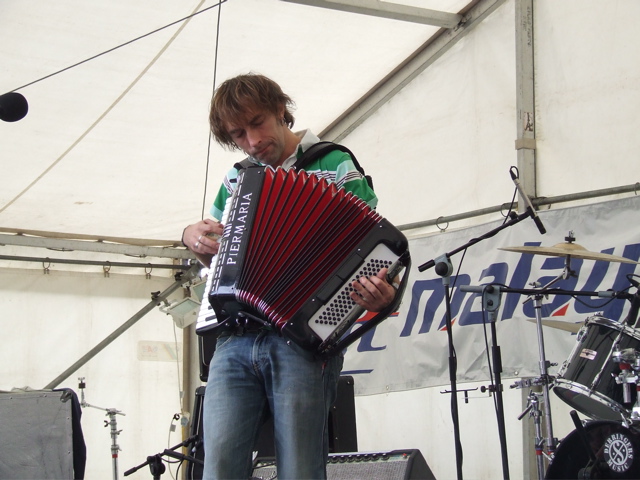
but damn did that band know how to rock out. Yann switched instruments between multiple guitars, violin, accordion, and mini-pianos (?) almost just because he could,

backed by a fat bass, cello (and other strings, albeit played like a cello), and second guitar, whose methods ranged between violin bow and electric drill to produce sound from the thing. It meshed so perfectly with the metamorphasised songs I knew and the newer songs I didn’t; I never imagined it, and it surpassed anything had I tried.

His skills on the violin and accordion really shone out. When playing those instruments, his whole physique would change, his face would soften, and his hands move faster than I could keep track — how can such music be possible?

As the first day was sublime, I made a trip of it on Sunday to repeat the whole event. And the second day in a row did not disappoint.

The only other thing I have to say is that his earlier music doesn’t make its mark on his demeanour; maybe I can’t see through the French exterior, but he looks far more haunted than I had imagined from his earlier music. The music direction I heard yesterday, frenzied and powerful, suits his face a lot more. But why should it be a beautiful man who makes beautiful music?

I regret terribly I didn’t approach and talk to him briefly, but what would I have said? In another lifetime…

2006/11/22

Resolution independence: the problem with bitmaps

I can’t keep up with the discussion on resolution independence that started a little while back and to which I added my thoughts the other day.

The IconFactory rebutted the claims about their vector image being composed of bitmaps — how else do we expect such effects to appear in icons? And fair enough. The field of raster image processing is far more advanced than vector; you need vector support for things like gaussian blurs in an image format before they can be included in a vector image. None of this is impossible (see Windows Vista) but it does require work.

Many people have been saying that high resolution bitmaps are all we need. And I challenge that claim. Again, I’ll reference Ian Griffiths; this time, see this article discussing Apple’s then-new 30 inch LCD display. In particular, note the visual artifacts shown in the “Click me!” button he shows; that’s the crux of the argument.

In a nutshell: bitmaps are fine, provided they exist by themselves. Icons, for example, possibly are best represented in some ridiculously large bitmap with a million pixels or so. All it’s going to do is sit on screen somewhere and presumably change size at various points. Nothing to worry about; decimation with low-pass filters (or whatever “smart” re-sizing algorithm you wish) works fine to rescale the image nicely (see Mac OS X’s Dock).

However, interface elements that have to align with each other must not exhibit scaling artifacts that are inevitable when dealing with raster images. “Resolution independence” implies that the sizes of interface objects can be specified in real world units (points, millimetres, inches, …) and render at the correct size. A bitmap has no provision to scale its internal features accordingly. What do I mean by this?

Say you’ve got the edge of a scroll bar rendered with blurs, transparency, whatever effects you like, and this has to mesh with part of the window that cannot be drawn as a bitmap of the same size. When these bitmaps are scaled, no matter how high their resolution, when it comes time to remove pixels from the image, rounding issues are going to affect which parts of the image stay and which are removed. Similar to anti-aliasing, a sharp hairline may end up a fuzzy mess if it doesn’t snap exactly to an integer number of display pixels. Bitmaps of different sizes will rescale and render such features in a non-controllable way. So you’ll end up with lines that change width when they shouldn’t or have off-by-one errors between adjacent interface elements.

And even with high-res displays, it’s surprising how much a “one pixel off” error stands out. This problem can only be solved satisfactorily (once and for all) if interface elements that must co-exist are all depicted as vectors and are sampled to the display resolution all as one.

To summarise: icons are fine as bitmaps. But there’s more to a graphical user interface than icons.

2006/11/19

iPod vs. iPhone vs. everyone else

At this stage, I’d wager that the iPhone will not exist. But before I go into that I’d like to provide some link love for people that write better than I. These things only tend to happen when I happen to read similar ideas in dissimilar articles, especially since my del.icio.us client broke. It’s just a coincidence thing, but the (localised) convergence of ideas makes me want to write.

Everyone’s favourite chocolate-inspired developer, Scott Stevenson, writes about user interfaces, primarily concerned with the (perhaps) storm in a teacup debate about whether bells and whistles are really necessary. And provides the first reference I’ve seen in years for the (classic) Mac OS Oscar the Grouch trash animation. “Oh I love trash!”. Anyway, let’s see if I can extract the idea he talks about:

Up until the last few years, a Mac app with a nonstandard user interface usually came about because the programmer didn’t know much about the Mac. They didn’t see any particular problem with using a push button as toggle switch. […] The other major difference is that this new interface concepts are designed by people that specialize in it. […] This is in stark contrast to Unix developers in the past who would basically make educated guesses about user interface.

Hold that thought for later — arbitrary engineers don’t know interfaces. In an unrelated article on Apple’s possible “iPhone”, jesper from sweden writes about how phone software (that is, the user interface of mobile phones) is, give or take, atrocious:

I have a Sony Ericsson model that can nail a note to the standby menu screen, and the Nokia I used to have slapped the Sony Ericsson around the block when it came to the address book.

I just checked, and it takes greater than six button presses, after the message is written, to send a message on my Sony Ericsson phone. Back when Nokia became popular, it was because they managed to design their entire interface around two buttons (the big button and cancel) and two navigation buttons, up and down — and it was the simplest, easiest phone on the market to use. The self imposed hardware restrictions forced them to design a good user interface.

Somewhere in there, the whole idea of simplicity was totally lost, and within a couple of generations Nokia phones were no better than all the others, with up to five or six or seven buttons to do various things and then four navigation buttons. Is it any wonder that people want “just a phone” these days?

There are so many preconceived notions I have about mobile phones, from how ring tones are annoying, to how predictive text could be so much better — give me a damn complete dictionary and make it pre-emptive and that’s a good start. To how the whole communication model just kind of happened; no-one thought through the popularity of asynchronous conversations via text messages. Could you do the same thing with voice? (Google just implemented something similar with Google Talk.)

What I’m trying to say is that there is a mold out from which Apple could very much break. Apple could design a phone without a numeric keypad. Think about it. When do you actually have to type numbers into a phone these days? Is it often enough to dominate the hardware interface?

Finally, Brian Tiemann writes about how the iPhone might not be a phone, but just an iPod. And he nails it. Why would Apple release a separate product “the iPhone”? John Gruber wrote earlier this year “Apple’s only serious competition [to the iPod] to date has been itself.”

It would be ludicrous to put aside the huge mindshare behind their most successful product and supplant the iPod with a superior device. “Are you getting an iPod?” — “Nah, the iPhone is so much better”. Apple trademarks names it doesn’t use just so other people can’t. Just as they did with the “iPod photo” (!) and the “iPod video”, Apple will release the “iPod phone” or “iPod talk” whose functionality will soon enough become ubiquitous enough that the suffix is dropped. (Let’s face it; the rumours are solid enough that something’s going on.)

Apple doesn’t seem to think its customers will be confused by having multiple products, over time, with the same name. There’s no need for a new name. It’s not the iPod X34, replaced by the iPod GH87, with its baby brother iPod LMP331. They’re just iPods, and people, unsurprisingly, seem to prefer the simpler title (if they even notice the dichotomy in nomenclature).

In summary: Apple’s gonna make a phone. But it’s going to be an iPod. And luckily, this time round, they didn’t paint themselves into a corner with an overly restrictive name for their product.

And that’s a selection of thoughts in my head from earlier this afternoon.

2006/11/16

Debunking an anti-vector art argument

There’s been some recent discussion on Mac OS X’s upcoming resolution independence. I’ve been interested for a while in this topic, but never managed to write about it much. Eighteen months ago Ian Griffiths discussed resolution independence in relation to Mac OS X’s upcoming support and what was already possible in Windows Vista. There’s a couple of good examples in there, for general interest.

A couple of people have chimed in on how you don’t want vector art, mostly because when you shrink it down you don’t get results as high quality as a hand-tweaked bitmap. There are two things here, exactly analogous to font technology. Long story short: you don’t want to shrink down a complex image too much, because you’ll lose detail and the smaller objects in the image will just disappear. Much better to design images for their display size; for example, thickening hairlines as the size decreases.

Over at the Iconfactory, they cover such points with another: vector art takes up more disk space when it’s complex. This is fairly untrue. They use the example of the same image in “vector” PDF and in bitmap PNG, with the higher-quality PDF a whopping 30 times bigger. And opening these files in an image viewer shows that displaying the PDF is far more processor intensive.

Seemingly damning evidence. However, zoom in real close to this image and you’ll see the reason this so-called vector image is so large: you can see by the individual squares of flat colour that it doesn’t use real vector gradients!

You can imagine that if this image is actually storing individual squares of colour at the size shown above (2000% magnification), then the file certainly is going to be enormous!

So what’s the deal? What has happened in this image is that their drawing program has rasterised the gradient into the vector image, resulting in an extremely high resolution texture in the image — resulting in the huge file size and slow processing seen. So in actuality, the image is not a true vector image.

To be a true vector image, the gradients themselves would have to be represented as vectors as well. Vector gradients cannot be as complex as the generated gradients as used in their image, but they are actually vectors. The display technology used to render the gradient would compute only the pixels being actually displayed in their subtly changing colours.

I’d like to conclude by quoting ssp, who has sensible things (as usual) to say:

I do think that using vector graphics in the process of icon design may be a good idea. Working with vector graphics seems to make people think more in terms of large structures than in terms of small details. And thus, for simplicity’s and clarity’s sake, basing an icon design on vector graphics may be a good thing to do.

Apple takes to the sky; airlines ‘amazed’

Recent news out from Apple announce iPod integration in airlines. This would be pretty nice, although something tells me it will be a first-class feature only; sad news for poor flyers.

In a perplexing turn of events, however, it turns out that the announcement may have been a little premature. A Dutch friend informs me that two of the airlines, Holland’s KLM and Air France, haven’t signed up to any agreement and actually are rather perturbed about the whole incident. Dutch article here, or a Babelfish snippet:

KLM reacted however astonished to the communication of Apple. “it is correct that exploring conversations have been but the chance that it does not continue is now much larger than that it continues, however,” a spokesman of the Dutch airline company said.

(Ah, automated translation. I wonder if Google’s service works better; it’s not available, yet, to translate from Dutch.)

This is the kind of thing you don’t expect to come out of Apple, given their notorious reactions to companies that do exactly this kind of thing to them. Considering they seem to all be airlines outside of America, perhaps there were wires crossed somewhere over the ocean. Without forthcoming information, and you can guarantee there won’t be, all we can do is watch on in amusement and puzzlement.

2006/11/05

Umberto Eco on religion

Stumbled across wise man Umberto Eco’s website where he has an artice About God and Dan Brown that closes with:

I think I agree with Joyce’s lapsed Catholic hero in A Portrait of the Artist as a Young Man: “What kind of liberation would that be to forsake an absurdity which is logical and coherent and to embrace one which is illogical and incoherent?” The religious celebration of Christmas is at least a clear and coherent absurdity. The commercial celebration is not even that.

Good stuff. To add some context, earlier in the piece:

Human beings are religious animals. It is psychologically very hard to go through life without the justification, and the hope, provided by religion.

I wonder if this will always be true. Science as a religion is still new (the philosophers seem to be ahead of everyone else, as usual) and there are millennia of religious devotion to overcome. I’m keen on the idea of a religion of society (clearly, we can’t all become hermits so we need to organise ourselves around something); would it be possible to craft that well enough to fulfil the hopes of the everyman?

Wine makes you strong

I like wine. You could say it’s somewhat of genetic trait; both my father and my grandfather have a “healthy” fondness for the stuff. I can’t speak for them, but I tend to find that I also can’t stop drinking it, especially when it’s half decent. I really cannot understand how people stop after a single glass.

Digressing for a paragraph; I’ve heard people say that in blind wine tastings of red and white at equal temperature, people only have a 50% success rate in guessing the “colour”. I don’t believe it in general, although I’m sure some reds and some whites do taste similar. There’s no way a shiraz and a riesling (again, half-decent) have anywhere near the same taste. But I do believe that most of the wine tasting experience is psychological.

Before today, I thought it was but a single glass of wine per day that was supposed to be good for you. But now I learn from the dubiously impartial red-wine-and-health.com:

The key to reaping the health benefits of red wine seems to be moderate consumption […] In the US, drinking in moderation means one glass for women, and one to two glasses for men.

Well, two glasses is better than one. But the good stuff follows…

The “sensible limits” in the UK and EU are two to three glasses of red wine per day for women and three to four glasses for men.

Huzzah! And we all know who live better out of the Europeans and the Americans. Presumably, the Europeans drink their four glasses over the course of the day, not all at once. Also, I guess that’s not four glasses in one of these 900mL beauties, either. That’s one dem fine wine glass, yes sir.

Not that you’d drink that much from one of those anyway, but I’m guessing they do mean four small glasses.

If I drank about 2 bottles of wine per week, that’d be around 10 cases per year. Assuming I’m drinking half-decent wine, that’s about $1000–$1500 per year for scientifically tested (and delicious) health benefits. I wonder…

2006/10/30

Brown rice

Brown rice is pretty awesome. It’s, like, tastier than white rice and better for you. So here I am, waiting to eat some…but the damn stuff takes so much longer to cook!

Anyway, while I wait, here’s my rice recipe. Easiest thing ever, really.

  • Half a cup of rice per person
  • Put in saucepan, add a dash of oil
  • Fry until it’s hot and water added sizzles
  • If white rice, add twice the volume of water as rice to the pot
  • if brown, add thrice
  • Stir the rice so it settles evenly under the water
  • Heat on high until it boils
  • Reduce heat so it’s not going to burn (but still bubble) and wait
  • Eventually, the rice will soak up all the water
  • Eat a little to check it's soft and not crunchy. This is very important. Add more water if the rice is not soft
  • When cooked, if desired, stir through butter for extra deliciousness

I’m pretty keen on rice, but I don’t eat it enough. I wonder if mine’s ready yet now…

2006/10/22

Tess of the d'Urbervilles by Thomas Hardy

Around the beginning of the year, I started reading fairly frequently; at the time a mix of fiction and non-fiction. Then I started Tess of the d’Urbervilles by Thomas Hardy (Project Gutenberg link to the free text [footnote one]), and either ran out of time or ran out of momentum to continue reading. It’s taken me until now to finish it; as always, it wallowed next to my bed until it gripped me and I read the second half in a few weeks.

Apparently, this is Lucy’s favourite book, and after absorbing the whole thing I can understand the sentiment. It’s not my favourite book, but I do think it is very beautiful, and I recommend sticking it out to the end if any of my hypothetical readers give it a try but find it slow going in the beginning. It was published in 1891, and is written in a style slightly more verbose than I prefer. On the other hand, I like Edgar Allen Poe’s style, so perhaps it’s the Englishness about the prose that doesn’t take my fancy. But powerful prose it is, and there are moments of real beauty in the novel.

The only way I can describe Hardy’s best writing is by analogy with figure/ground. Rather than a description of something directly, he writes around the subject, with hardly a reference to it, and with such detail to give the mind space (and time) to fill in the details of what was left implicit. (I wonder if this was also to tread around delicate subject matter.) The most poignant scenes, at the end of the first part (Ch. 11) and the very end of the book, impressed me more than most writers I can think of.

Without sufficient context of what life was actually like in the late 19th century and the social setting into which the book was published, it’s a little hard to pull out the same messages from the text as were perhaps intended. The emotions and motivations of the characters are very real, however, and while the story has its anachronisms, it hasn’t dated. I found it interesting that Hardy, through the character Angel Clare, puts emphasis both on the lifestyle of working class and simultaneously espouses philosophy over religion.

When I read books sometimes I write quotations of small sections that strike my fancy. This first follows from what I was saying in the previous paragraph. From Chapter XX: (emphasis as original)

Their position was perhaps the happiest of all positions in the social scale, being above the line at which neediness ends, and below the line at which the convenances begin to cramp natural feelings, and the stress of threadbare modishness makes too little of enough.

(The internet tells me that convenances means proprieties or conventions.)

From Chapter LIII:

Thus they passed the minutes, each well knowing that this was only waste of breath, the one essential being simply to wait.

Finally, nothing profound but this one tickled my fancy given my profession. From Chapter XLVII:

His fire was waiting incandescent, his steam was at high pressure, in a few seconds he could make the long strap move at an invisible velocity. Beyond its extent the environment might be corn, straw, or chaos; it was all the same to him. If any of the autochthonous idlers asked him what he called himself, he replied shortly, “an engineer.”

(“autochthonous” is apparently “native to a particular place”.)


[footnote one: It’s a pity the typesetting isn’t as good as it could be.]

2006/09/28

God’s Debris by Scott Adams

I was recently recommended Scott Adams' book “God’s Debris”, which may now be freely downloaded. This will presumably drive sales of the sequel, which is currently only available in paper form.

It’s a pretty short book, and very easily digestible. Turns out that Scott Adams isn’t just a terribly funny guy (via Dilbert), but he’s also an exquisite composer of thought experiments. He proposes a possible truth to the universe, ostensibly not as an explanation for anything but more to explore the issues involved. As someone occasionally on the fence regarding spiritual vs. reductionist beliefs, this is the sort of thing to swing me rather firmly towards the latter.

His descriptions ring especially true for reductionists that believe all things may be described by the sum of their parts. In his blog, Scott refers to humans as “moist robots”, which gives some sort of feel for the way he approaches the meaning of the universe in this book. His own views, of course, are concealed as unimportant.

Scott suggests reading the book with a friend and discussing the issues raised over a tasty beverage. I wish I had that luxury, so I’ll just say that I’ve read it (thanks Justin!) and hope that someone wishes to talk to me about it some time. As a philosophy to live by, it certainly fits in better than any other supposed explanation I’ve ever read. (Especially this one.) But the point is — I feel — that there’s really nothing we can do to validate any such claims and the best thing for everyone to do is live by a “religion of society”. If some people need fictions to adhere to such a philosophy, then that’s the way it goes.

Anyway, I promise I’ll stop being wishy-washy metaphysical. I’m just spewing thoughts into the ether while they exist in my head.

2006/09/26

Living so long

I’ve recently been telling people that it’s my goal to live ‘til I’m 150. Imagine the coincidence that Scott Adams expressed living to a similar date. Hence, a reminder to write something.

I was mainly inspired by some of Ray Kurzweil’s writing which can essentially be summed up by saying that technology increases exponentially and it’s impossible for us to conceive what’s going to be around in 20 years.

Case in point: I don’t think the step from a 8MHz Mac Plus in 1986 with 1MB of RAM no hard drive, and a 9 inch black and white monitor to a dual-core 2.16 GHz iMac with 1GB of RAM and a 24 inch colour monitor was exactly anticipated. Well, Moore’s law would have predicted it (doubling every 2 years is an order of magnitude increase in 20), but looking back 20 years gives a better perspective — we’ve come a long way.

So anyway, living to 150 gives me heaps of time. What on earth am I going to do with it? I guess to start I need to make sure that my lifestyle is actually conducive to living so long. And, well, I pretty much have no clue. I’ve started exercising some, which my physio friend assures me (if I keep it up) is a big win when I get to about 50 and my body starts deteriorating.

Eating well is what bothers me. I must eat relatively well compared to some, but I still wonder. Do vitamin pills do anything, or are they passed through the body as placebos? How do I know if I get the optimal combination of proteins and whatever? Is a vegan diet with supplements better than a moderated omnivorous diet? How much attention should I spend on organic food?

Et cetera. So I’m really hanging out for the day that we can have sensors living in various parts of our bodies informing us of these sorts of things.

* BeepBeep * You need more potassium. Eat a banana.

Or whatever. I’m also waiting for built-in heart monitors and GPS receivers, which have moderate uses for tracking exercise, but most importantly EEG sensors that let you know the optimal times at which to nap (and whatever else they’ll be able to tell us).

I figure with enough optimism, there’s not too much we won’t be able to achieve before I’m dead. People express surprise that I want to live so long. I don’t really understand that. What’s the rush?

Religion vs evolution

This post came to mind months ago walking home one day, but I didn’t have the motivation to flesh it out at the time. The idea I’ll briefly discuss stems from when I read Dawkins’ book “The Selfish Gene” (which I should have summarised at one time but evidently didn’t — I read it after Daniel Dennet’s “Consciousness Explained”) wherein he essentially talks about how everything can be explained by how various evolutionary forces shape their creation.

Some trawling through the archives of Scott Adam’s “Dilbert Blog” re-awoke my idea, which I present below. There’s not much to it, really. I just found it interesting to muse on for a few minutes.

Religion seems like a mighty odd thing. I separate it into two broad components: the “supernatural” elements that help to “explain” things that we otherwise can’t; and (more importantly) various guidelines that help shape the behaviour of the religion’s followers. The question that I was thinking about was “why would groups of people believe all these crazy things in unison?”.

The explanation that someone just dreamed it up (probably believing it themselves) as a theory to explain something incomprehensible makes a fair amount of sense. I don’t think that covers everything though. Why would such beliefs be “evolutionarily stable”? That is, in a group in which half believed in God and in which half didn’t, what process would govern whether subsequent generations were more or less religious?

And here the social aspects of religion rear their head. It seems to me that when people embrace religious beliefs, with their associated “harm ye none” (in general)attitudes, their society or community is advanced due to the (generally sensible) guidelines given by their religious leaders. So now the religious half of the control group prosper due to their moral code, which just so happens to be independent of their belief in whatever precepts their religious holds.

To sum up the argument, the claim is that a group of religious people due to their community will tend to dominate. I feel I’m ignoring a host of factors here, such as the whole “meme” issue that religious thought propagates by affirming faith over reasoning — you can never really win a fundamental argument against such people. But I think it’s not too much of an exaggeration to say that if religion of itself weren’t beneficial it wouldn’t exist.

That’s kind of the end of the story. I told you it wasn’t interesting. (Isn’t that what the internet’s all about?) I could now say that it’s a problem that religion is in decline, because the unwashed masses are no longer living unconditionally by tenets that they otherwise would (lest they be smote). And in the 21st century, what inducement can be made for them to do so?

2006/09/11

Impossible Music Festival 2006

The radio station TripleJ in Australia does really great stuff. I don’t know how it compares to radio elsewhere in the world, but I like it a lot. They do a lot for the Australian music industry, such as support touring bands (how, I’m not actually sure…) and discover new artists (you might have heard of Missy Higgins). And provide free music to download, which is always nice.

(They’ve recently launched JTV, which runs mostly on ABC2, a digital-only free to air channel, which shows live recordings and other radio-type stuff that would be appropriate to actually watch. Check out the JTV website rather than hear me inadequately describe it, which even features “vodcasts” of some of their material.)

This year, JJJ’s repeating their “Impossible Music Festival”, in which they take votes for a whole bunch of live recordings they’ve taken, and then proceed to play only that live music over the course of an entire weekend. My highlight last year was Muse, who seem to be even better when left to their own devices — except on their official live album, Hullaballoo. I guess they’d get bored of playing the songs the same every time, or something.

In the hope of being able to listen to that recording again, I’ve voted. Included for your (perhaps lack of) interest, here’s my shortlist. Only ten were allowed, and JJJ doesn’t have a recording of the Pixies. In hindsight, I might have shuffled some choices around, but no matter.

2006/09/02

The Dears on iTMS: Stupid

As much as I want to like the iTunes Music Store, it continually disappoints me. It’s really easy to buy music, yes, and it’s often quite cheap. But in the Australian version, there’s so much weird crap that leaves me with a bad taste in my mouth.

For example, I checked out the new “The Dears” album today, and look what I found:

Uh, great. Two of the same thing, one half again as expensive. What’s the difference? The first is a regular iTMS album at the normal price:

The second has an EP stuck on the end (note the track numbering):

So, I could either buy the album at $17, and buy the tracks to the EP individually at $1.70 each for a grand total of $23.80. Or I could skip the hassle and buy them all at once for $27.04?!?!

What’s worse, their first album is only available for $33.98, which includes their “Protest” EP. Why even bundle them together in the first place? The US store doesn’t, and lists the album for US$10, the EP for US$4.00.

It’s senseless things like this that really makes me wonder how incompetent the Australian iTMS people are, or whether it’s some stupid music labels thing. Don’t even get me started on how Sigur Rós is represented in the iTMS. The whole thing’s ridiculous.

2006/08/28

XML document formats (and TeX)

This post began as just a teeny tiny mention of how, with Apple supporting OpenDocument in its next release, TeX supporting unicode and OpenType fonts, and Microsoft Office using Open XML, things are going to get interesting in the document applications arena over the next few years.

But the comments thread in that last link got me going. There’s been beef apparently between the OpenDocument people and Microsoft, whereby the former believe that Office should have just used their solution and Microsoft didn’t want to fit their feature set into what ODF provided. Similarly, MathML wouldn’t have worked as a document format without extending it to support other Office features (track changes, e.g.), and that’s one of the main criticisms generally of how Microsoft “supports” standards (embrace, extend, …). David Carlisle (of LaTeX3 project fame, from my point of view) put things more eloquently in the thread under discussion.

The odd one out in all of this are the TeX-based solutions. While xmlTeX can parse, uh, XML, and ConTeXt can handle MathML, it becomes hard for me to see where or how TeX-based markup documents can co-exist with MathML apps (which will be able to copy/paste editable equations like plain text). You’re not going to want to insert some hideous MathML into your otherwise nicely marked-up TeX doc:

<math>
  <mo> &sum; </mo>
  <msupsub>
     <mi> x </mi>
     <mn> 3 </mn>
     <mi> i </mi>
  </msupsub>
</math>

But it seems that isn’t so much a problem after all, with a quick search resulting in a highly relevant paper on [MathML to TeX conversion]. The problem, finally, is editor support. With tagged PDF allowing MathML copying from PDF documents (correct me if I’m wrong, but I believe this is possible), and editor-based MathML to TeX conversion into the source, TeX would work just as well as, say, Office 2007–Mathematica (to give but an example of MathML applications) as a first-class copy/paste citizen — a situation that’s not true today.

2006/08/24

Text in UI design

Sometimes feeds roll in articles that are surprisingly congruous. Over at Impulsive Highlights there’s a screenshot (which will surely be removed soon) of an upcoming preferences panel in a Leopard app for decompressing zip files.

Sometimes you want to keep the zip file after expanding it; sometimes you don’t. (A brief shoutout here to the old Stuffit archive format since I’ll never have the chance again. It was great back in the nineties when you’d get a progress meter saying things like “Unstuffing 34 files” — I still remember the comment about how on a PC it was a lot more boring to decompress files!)

Back to this preference panel; it offers an option called “Keep unarchiving dearchived file(s)”. Either it’s someone’s idea of a joke, filler text to be improved in the future (and I love it!); or it’s a classic example of why programmers shouldn’t write interfaces. Really, “unarchiving dearchived…”? So great.

At the same time as this nugget crosses my reading path, I also come across ‘The long road to simple: creating, debating, and iterating “Add an event”’. Here, the 37signals guys show how much work is required (or, at least how much work they do) on iterating a single text element in an interface to achieve the right mix of consise-ness and explainability. Wonderful stuff.

2006/08/21

Lemon jam

We’ve got heaps of lemons:

Somewhere along the line I got the idea that it’d be a pretty good way of getting rid of them by making lemon jam. Or lemon marmalade. Or lemon jelly.

Turns out you only need like six lemons to make enough jam for a couple of months. So the long term goal of actually using those lemons is still a little way off. (I’ve started squeezing them into ice cube trays, but I’m dubious if we’ll need kilos of the stuff.) But the process of making the jam, which I now highly recommend, was a bit of fun, and the recipes I found for it were a little confusing in their variety. I just sort of interpolated on the easiest ones.

I think the fact I chose the easier recipes makes what I made lemon jam, rather than marmalade, which seems to be more complicated. Don’t even talk to me about glass jars; I just use a recycled plastic honey container.

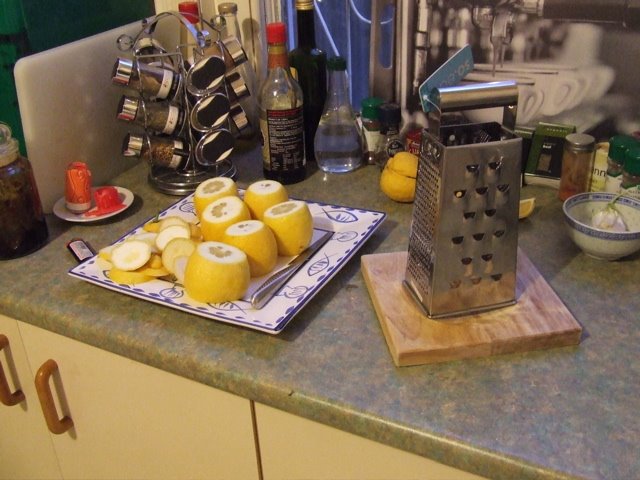
First step in the process was to pick the lemons and wash them. And try and remember that boiling the things for an hour would kill all the germs from bird poo. Gross. So, I started off with about a kilogram of lemons:

The first time I made lemon jam, I peeled them and cut the rind into little pieces. This time, it was much easier just using a grater. I chucked this in a huge pot with about 1.4 litres of water.

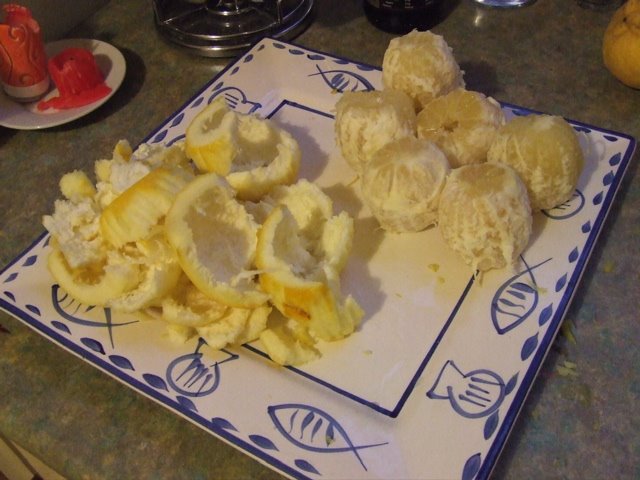
Since the white stuff on the outsides ("pith") of these lemons was so thick, I didn’t want to use any of it in the jam. (Last time, I added a little and it became a little bitter; add to taste, I suppose.) After taking off all the peel, I realised that I’d lost fully half of the mass of my lemons. So I put in two more just for luck.

Since the lemons are boiled for ages, it didn’t matter that I cut them into fairly coarse pieces to add to the pot.

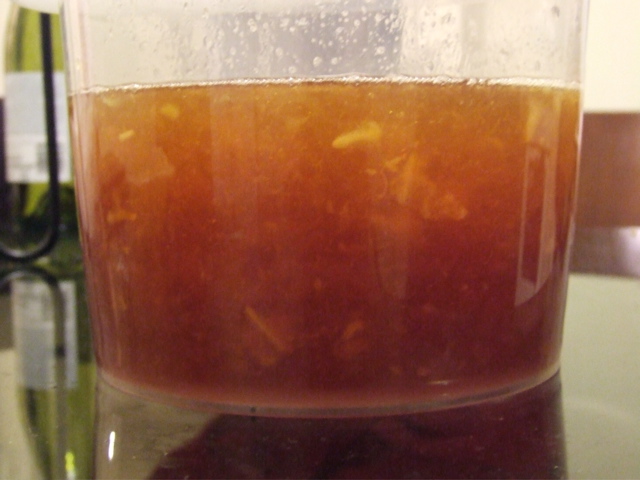
Then it’s just a matter of waiting. This time ‘round, I boiled the lemons for an hour with the lid on, then took the pot off the heat. (I’m wary of burning the sugar in the next step after an unfortunate housemate incident.) At this stage, the whole house smells like lemon. Yum. But not too good to eat. Now we need sugar. I added about 1.25 kilograms of it, stirring it in as I went.

Finally, I boiled the mixture and left it simmering for about another hour. Apparently I was supposed to be skimming off the foam, but I didn’t. You can tell it’s done when a little jam left on a spoon to cool sets to a jammy consistency.

So, 8 lemons down, 92 to go. To summarise:

  • Wash eight thick-skinned lemons
  • Grate the rind
  • Peel the lemons, discard most or all of the pith
  • Cut the flesh into pieces
  • Boil the rind and the lemon flesh for an hour in 1.4 litres of water, or thereabouts
  • Slowly dissolve in 1–1.5 kg of sugar
  • Boil for another hour
  • Yum!

2006/08/14

Time Machine not quite so ugly after all

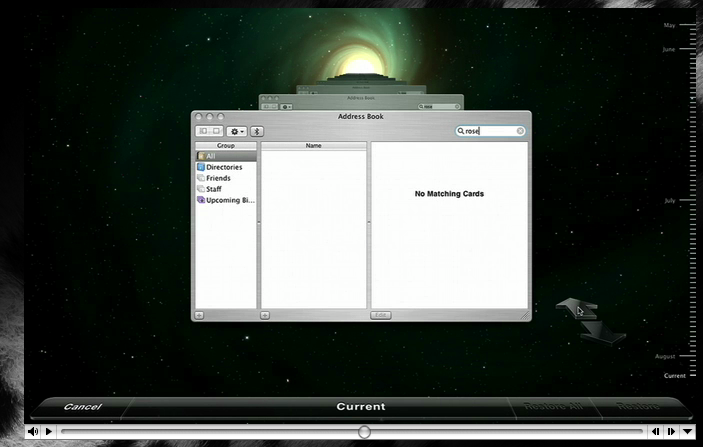
Okay, so there’s some slight good news on the interface front. While Preview.app has gone done the drain with those awful blue pill buttons, Time Machine is more toned down than shown in the keynote. Here’s the version shown publicly on apple.com:

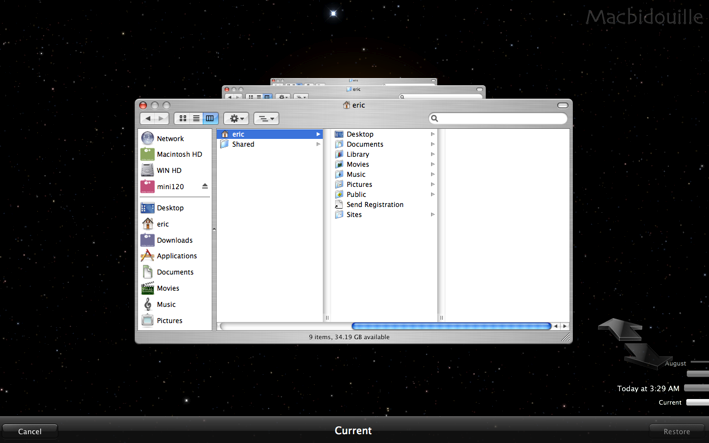
And here’s the version shown on HardMac:

I’m pretty keen on the update, although I think the bottom panel can still be improved. Fingers crossed that I’ve gauged the direction of the user interface evolution correctly; it could well be that the ugly version is the more recent!

Anyway, say what you will about the appropriate-ness of the interface. Those moving stars in the background get my vote any day. Teehee.

2006/08/08

WWDC: Paul Thurrott vs. the Mac community

Just a quick link to Paul Thurrott, who has the audacity to bitch about the newly announced features of Leopard. He’s got a couple of good points. For me, I find it’s the last 10% that makes the update worthwhile, rather than the big ticket demos.

But people in the tech community, i.e., those who should know better, really have to stop taking marketing so seriously. WWDC is covered by, like, mainstream media all over the world, so of course it’s going to be saturated with (a priori overblown and possibly propaganda) marketing. And of course Mac OS X is playing catch-up to Vista. That’s the whole nature of competition.

By now, it should be obvious to anyone interested that Vista’s going to be very feature rich, no doubt over and above Mac OS X (e.g., all the media centre and tablet PC software that Apple doesn’t, regrettably, have the hardware to support). Hell, Steve didn’t even announce anything about resolution independence. And those “top secret” features he doesn’t want to mention yet? Read “not ready yet even for public demonstration”. Here’s for a revamp of the interface (that the interfaces shown are so similar to Tiger’s this idea bears some consideration — and oh god! Mail still makes my eyes bleed).

I’d also like to see features based around resolution independence such as “online Exposé”, whereby background app windows are shrunk by a user-specified magnification factor (the inverse of Dock magnification, of sorts). Not to mention transparent support for high-res displays. I actually expected new displays today with resolution in the order of 200 dpi, but you can’t please everyone. I guess the LCDs just aren’t ready yet for any reasonable price.

Reactions to Leopard: Time Machine

Some details have been revealed for Mac OS X “Leopard”, which will be available circa the same time as Windows Vista. I couldn’t watch the keynote, either through network difficulties or plain congestion. But I’ve some comments on the new features, even if I’ve only got annoying voice-over man to explain them to me.

The most plainly useful, and innovative, feature of Leopard is its backup support through the “Time Machine” feature — see Apple’s explanatory video. John Siracusa discussed the need for this last November: (boy, where has the time gone?)

Her Mac has made creating and organizing digital content so easy that it now contains gigabytes of the stuff. I often find myself thinking ominously about the consequences of a catastrophic hard drive failure in her now almost three-year-old iMac. All those photos, all those movies, just…gone. Poof!

I’m similarly worried about my own computer at the moment, since I’ve a PowerBook with no good backup plan in place. John above proposed two hard drives in every Mac purely for the sake of data redundancy, and this is a stellar plan. “Time Machine” in Leopard is the software component that makes it even better, and is literally better than anything I imagined Apple (or anyone else) would implement. This is more than just backup.

It’s not clear to me how accessible the hooks here will allow such a thing, but imagine text editors being able to visually diff, in real time, content through revisions. That’s system wide changes-tracking, and better than what everyone harps on about in Microsoft Word. I’m now expecting this exact feature in iWork’07. More generally, will Time Machine make local version control systems redundant?

I’m with Jon Hicks though: deep space background with grotesquely distorted type (fine, “in perspective”) at the base of the screen? This could be so much more elegant while still retaining its wow factor. On the other hand, considering how infrequently — and in which contexts (oops, I overwrote a document I need; or, help! where’s my stuff?!?) — I expect the feature to be used as in the demo, I’m not even sure that such a whiz-bang interface is even appropriate! Hopefully there’ll be at least some minor visual tweaks before the final release. Don’t get me wrong, however, I think the basic premise behind the interface is fine. It’s just the useless 3D buttons and background I’m railing against here.

More comments on Leopard as time allows…